Regenerative Aesthetics
Stem Cells vs PRP: What’s the Difference?
If you’ve been looking into regenerative treatments, you’ve probably seen two terms come up again and again: stem cells and PRP, or Platelet-Rich Plasma. They sound similar, they’re often mentioned together, and both are used to support skin and tissue health. But they are not the same. At True Bliss Medical, patients often ask which option makes more sense for their goals. Under the care of Dr. Alexander Rios, MD, the focus is on helping you understand the difference clearly so you can make an informed decision.
Stem cells and PRP are both used in regenerative aesthetics, but they work differently. Learn how PRP growth factors compare with stem cell-based approaches and why consultation matters.
In This Article
What Is PRP?
PRP stands for Platelet-Rich Plasma. It comes from your own blood. A small amount of blood is drawn, placed in a machine that separates the components, and the platelet-rich portion is collected for treatment.
Platelets contain growth factors, which play a role in healing and tissue repair. In aesthetics, PRP is often used to support skin appearance, texture, and general skin health by encouraging the body’s natural processes.
- Comes from your own blood
- Uses the platelet-rich portion of the sample
- Contains growth factors that support healing and tissue repair
- Often used for early-stage skin support and texture concerns
What Are Stem Cells?
Stem cells are different. They are special cells that can develop into different types of cells, support repair processes in the body, and help maintain tissue health.
In aesthetic treatments, stem cells are often taken from fat tissue. These are called autologous stem cells, meaning they come from your own body. Stem cell-based approaches are generally more complex and are often discussed as part of a broader regenerative plan.
- Can develop into different types of cells
- Support repair processes in the body
- Help maintain tissue health
- Are often collected from fat tissue in aesthetic settings
The Core Difference
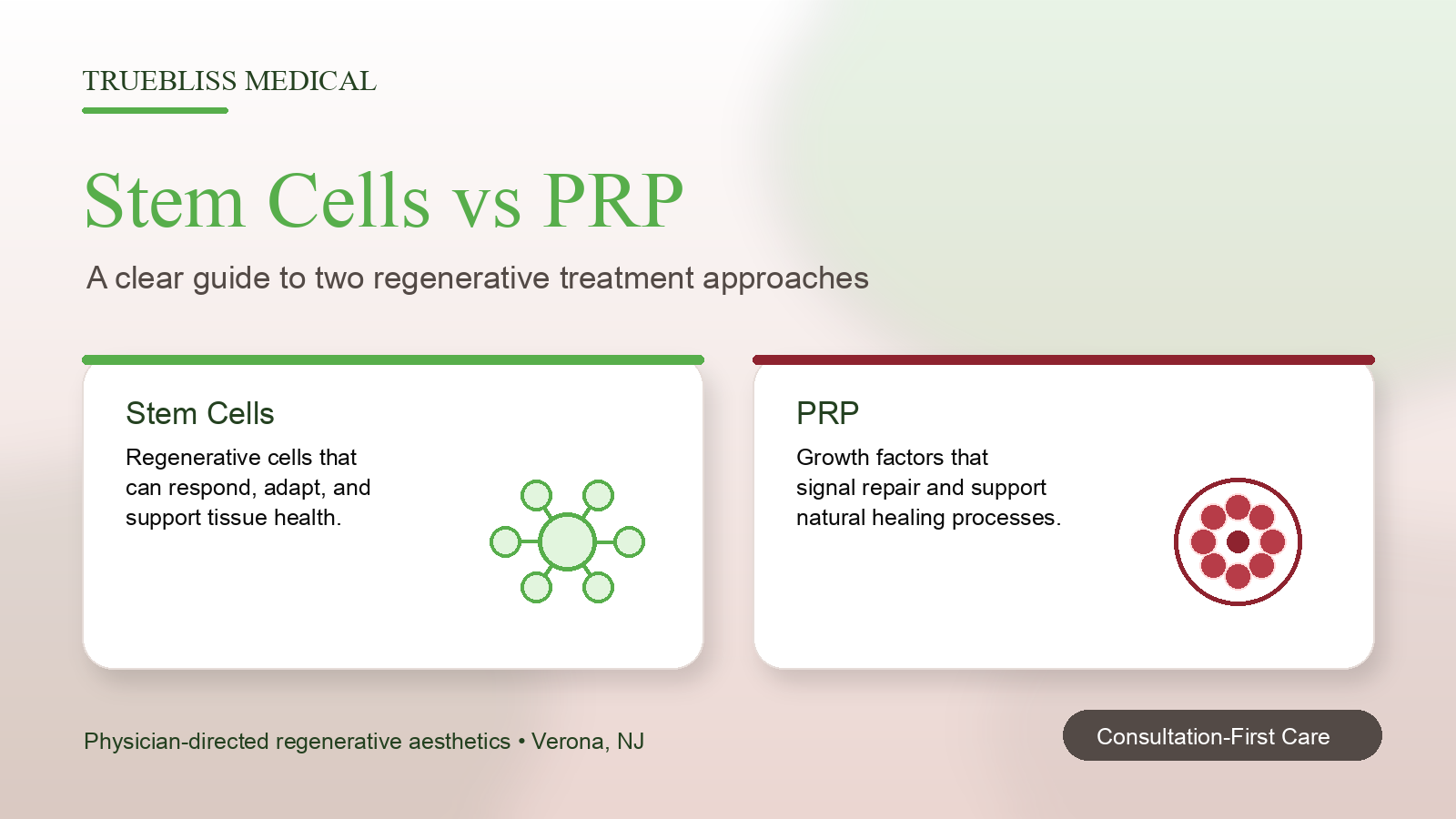
The simplest way to understand the difference is this: PRP sends signals, while stem cells can respond and adapt. PRP provides growth factors that support healing. Stem cells have the ability to participate more directly in regeneration.
This does not mean one option is automatically better than the other. It means each has a different role, a different level of complexity, and a different place in treatment planning.
- PRP delivers growth factors
- Stem cells are regenerative cells
- PRP signals repair processes
- Stem cells may participate more directly in repair processes
- The right option depends on your goals, health history, and treatment plan
How PRP Works
PRP works by delivering growth factors that may help stimulate your body’s natural processes. It is often used to support skin appearance, texture, and overall skin health.
Think of PRP as a way to encourage your skin to respond. For many patients, it may be considered when they want a simple, minimally invasive treatment or early-stage support.
- Supports skin appearance
- May help improve texture
- Encourages natural repair signaling
- Often involves a shorter, straightforward process
How Stem Cells Work
Stem cells go a step further. They are involved in processes that support tissue repair, cellular activity, and long-term skin health.
They are often used in more advanced regenerative approaches. Think of stem cells as part of the body’s internal repair system, which is why consultation and proper medical guidance are so important.
- Support tissue repair processes
- May support cellular activity
- Can be part of long-term regenerative planning
- Require careful evaluation and medical guidance
Key Differences at a Glance
PRP and stem cells are related to regenerative medicine, but they are not interchangeable. PRP commonly comes from blood and focuses on growth factors. Stem cells are commonly collected from fat tissue in aesthetic settings and involve regenerative cells.
PRP is usually a simpler process and may be considered for early or mild concerns. Stem cell-based approaches are more complex and may be discussed for more advanced or long-term planning.
- Source: PRP comes from blood; stem cells are commonly collected from fat tissue
- Function: PRP provides growth factors; stem cells are regenerative cells
- Role: PRP signals repair; stem cells may participate in repair processes
- Complexity: PRP is generally simpler; stem cell-based approaches are more complex
- Use case: PRP may fit early concerns; stem cells may fit advanced planning
Which One Is Right for You?
This depends on your goals. PRP may be a good option if you want a simple, minimally invasive treatment, are looking for early-stage support, or prefer a shorter and more straightforward process.
Stem cells may be considered if you are interested in regenerative approaches, are thinking long-term, or want to explore more advanced options. The choice is not about which is better. It is about which fits your situation.
- PRP may fit patients seeking simple early-stage support
- Stem cells may fit patients exploring advanced regenerative options
- The best option depends on your goals and medical history
- A personalized consultation helps determine what makes sense
Can They Be Used Together?
In some cases, yes. PRP and stem cells may be part of a broader plan because each has a different role. Combining approaches can be considered depending on your goals and the medical recommendation.
A personalized consultation helps determine whether one approach, both approaches, or a different treatment plan is appropriate.
What About Results?
It is important to keep expectations realistic. Both treatments support natural processes and work gradually over time. They do not create instant dramatic changes, and results vary from person to person.
At True Bliss Medical, the conversation focuses on realistic expectations, medical guidance, and treatment plans that match the patient’s goals.
- Results are gradual
- Both treatments support natural processes
- Neither treatment guarantees a specific outcome
- Individual results vary
Safety Considerations
Both PRP and stem cell-based approaches use your own biological material. This can help reduce certain risks, but proper handling is still essential.
Qualified medical professionals should perform these treatments, and not all uses are the same or appropriate for every patient. FDA-compliant guidance is essential when discussing regenerative options.
- Proper handling matters
- Qualified medical professionals should perform treatment
- Not every use is appropriate for every patient
- FDA-compliant guidance is essential
Why This Conversation Matters
Regenerative treatments are becoming more common, and with that comes confusion. Patients often hear words like natural, regenerative, and advanced without clear explanations of what those terms mean.
At True Bliss Medical in Verona, NJ, the goal is to keep things simple, clear, and grounded in medical guidance. Dr. Alexander Rios, MD evaluates your skin condition, goals, and medical history before recommending a plan.
Common Misconceptions
PRP and stem cells are not interchangeable. Neither treatment guarantees specific results. And more complex does not always mean better.
Understanding these points helps you make informed decisions and avoid choosing a treatment based only on buzzwords.
- PRP and stem cells are not the same
- Neither treatment guarantees a specific result
- More complex does not always mean better
- Clear consultation is the best next step
Final Thoughts
Stem cells and PRP are both used to support the body’s natural processes, but they are not the same. PRP delivers growth factors that signal repair. Stem cells are part of the body’s regenerative system and may support deeper processes.
The right choice depends on your goals, timeline, medical history, and comfort level with different types of treatment. If you are considering either option, a consultation is the best next step. It allows you to understand what is appropriate for your situation and how these treatments may fit into your overall plan.
About True Bliss Medical
True Bliss Medical is located in Verona, New Jersey, and serves patients throughout Essex County, including Montclair, Caldwell, West Caldwell, West Orange, Livingston, and Cedar Grove. Our practice focuses on advanced, physician-performed aesthetic treatments designed to enhance natural beauty without surgery.
Next step
Considering PRP or stem cell-based regenerative treatments? Schedule a consultation with Dr. Alexander Rios, MD, at True Bliss Medical in Verona, NJ, to review your goals and learn what approach may be appropriate for you.
Considering this treatment? Explore Exosome Therapy at True Bliss Medical in Verona, NJ.
Book a ConsultationContinue reading